Lost in Translation: What Happens When We Breed the Voice Out of Dogs
Docked tails, flat faces and heavy coats don’t just affect how dogs look — they affect how clearly dogs can communicate. Discover why some breeds struggle to be heard and what that means for their welfare and safety
6/14/20265 min read
In the last blog, we talked about how dogs evolved an extraordinary communication system — one pointed directly at us, refined over thousands of years to be clear, consistent and remarkably sophisticated. But here’s the problem. In the last few hundred years, we’ve been quietly dismantling it. Not deliberately. Not maliciously. But through selective breeding choices that prioritised looks, working function, or human preference over a dog’s ability to communicate clearly — we have, in some cases, bred the voice right out of them. And the consequences are serious.
Communication Isn’t Just Noise
When we talk about dog communication, most people think of barking. But the vast majority of what dogs say has nothing to do with sound.
Dogs communicate through:
Ear position — forward, back, flattened, swivelled
Tail position and movement — height, speed, direction of wag
Facial expression — brow raises, lip tension, eye softness or hardness
Body posture — weight distribution, muscle tension, how they hold their spine
Movement — approach angle, speed, whether they curve or come straight
These signals are nuanced, layered and constantly changing. A confident dog approaching a stranger looks entirely different from an anxious one. A dog who is uncomfortable but coping looks different from one who is about to reach their limit. Other dogs read these signals instinctively and accurately. Humans, when educated, can learn to read them too.
But what happens when the signals themselves are physically compromised?
When the Anatomy Can’t Tell the Truth
Let’s start with tails.
A dog’s tail is one of their primary communication tools. Height, speed and direction of wag all carry different meanings. A tail held high and wagging stiffly signals arousal and potential tension. A tail tucked low signals fear or submission. A loose, mid-height wag signals relaxed friendliness. Now imagine that tail is docked. Docking removes most or all of the tail, leaving a stub that cannot convey the same range of signals. Other dogs struggle to read docked dogs accurately. Studies have shown that dogs with docked tails receive more aggressive responses from other dogs — not because they are more aggressive, but because they are harder to read. The ambiguity itself creates tension. A dog who cannot signal clearly is a dog who is more likely to be misunderstood. More likely to find themselves in conflict they didn’t invite and couldn’t prevent.
Now let’s talk about ears.
Natural, mobile ears are extraordinarily expressive. They flatten in fear, prick forward in alertness, swivel toward sound, and soften in relaxation. They are a constant, real-time broadcast of emotional state. Cropped ears — surgically altered to stand permanently erect — are frozen in one position. They cannot flatten. They cannot soften. The nuance disappears entirely. Even without surgical alteration, heavily dropped ears — like those on many spaniels and hounds — have reduced mobility compared to pricked ears. The signal is quieter. Easier to miss.
The Flat Face Problem
Brachycephalic breeds — Bulldogs, French Bulldogs, Pugs, Shih Tzus, Boxers — face a different but equally significant challenge. Dogs communicate a huge amount through facial expression. The inner brow raise we talked about in my last blog. Lip tension. The softening or hardening around the eyes. Subtle muscle movements that other dogs and attentive humans learn to read.
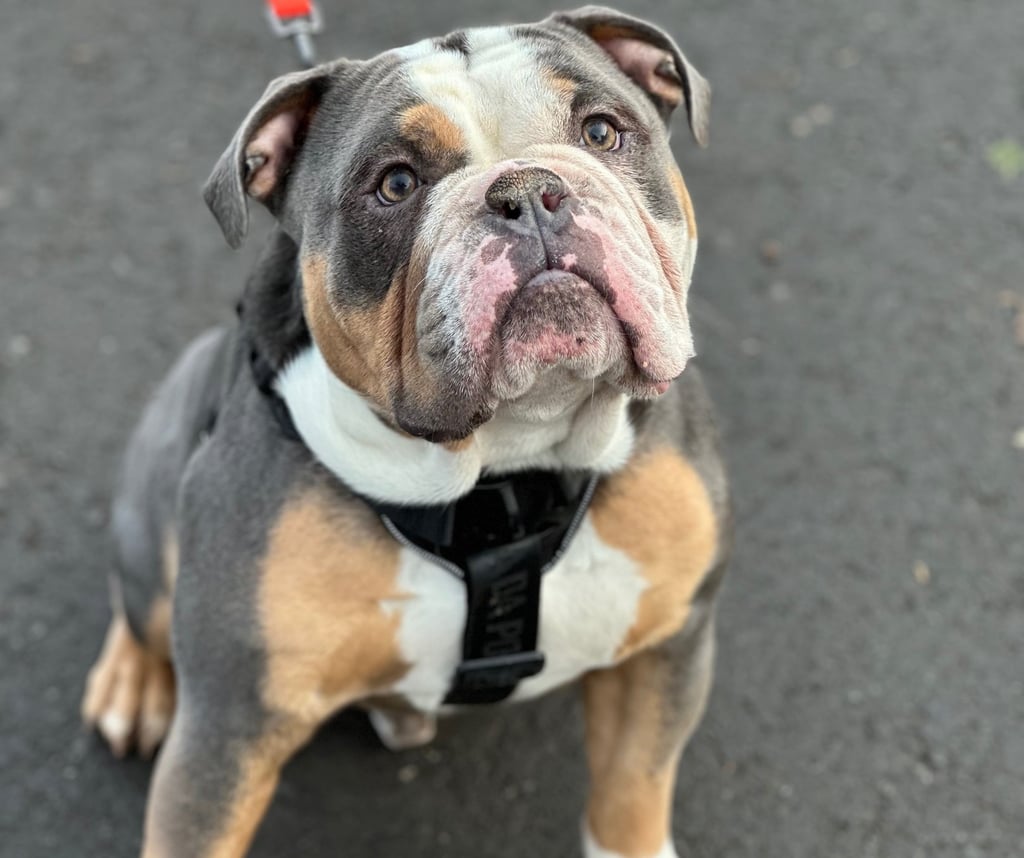
Brachycephalic breeds have compressed facial anatomy. The muscles are there, but the structure they work with has been dramatically altered. Expressions that would be clear on a longer-faced dog become ambiguous or invisible on a flat face. These dogs are not less expressive emotionally. They feel everything. They are trying to communicate. But the physical apparatus to do so clearly has been bred away. The result is dogs who are chronically misread — by other dogs and by humans. Dogs who signal discomfort and are missed. Dogs who are pushed past their limits because nobody saw it coming. Dogs whose “this is too much” looks, to an untrained eye, identical to their “I’m fine.”
The Coat Problem
It’s not just anatomy. It’s also coverage. One of the most important things we watch for in dogs is muscle tension. A dog who is stiffening, whose weight is shifting, whose hackles are beginning to raise — these are critical early warning signals. On a short-coated dog, these signals are visible. On a heavily coated breed — Old English Sheepdogs, Chow Chows, some Pomeranians, heavily coated GSDs — muscle tension, hackle raise and weight shift can be almost entirely hidden under layers of fur. We are reading a dog through a disguise.
What This Means in Practice
This isn’t abstract. It plays out every single day in homes, parks and training classes across the country.
The Bulldog at the dog park who is deeply uncomfortable but whose flat face makes it impossible to tell. Who gets approached again and again because nobody reads the warning. Who eventually snaps — and is labelled aggressive — when actually they were shouting for help in a language nobody could hear.
The docked Spaniel whose tension another dog can’t read, leading to a confrontation that neither dog wanted or initiated.
The heavily coated dog whose owner has no idea their dog has been uncomfortable for the last ten minutes because the signals were buried under fur.
These are welfare issues. Real ones. And they are a direct consequence of breeding choices that prioritised aesthetics over communication.
This Is Not About Blaming Breeds or Their Owners
This is important. Dogs in these breeds are not broken. They are not dangerous. They are not lesser. They are dogs who have been placed at a disadvantage by the choices made about how they were bred — often long before their current handlers were born. Understanding this should make us more compassionate toward these dogs, not less. More attentive. More willing to learn their individual signals even when those signals are harder to read. It should also make us think carefully about breeding standards, about what we select for, and about whether the look we find appealing is coming at a cost to the animal living inside it.
What We Can Do
The good news is that education changes everything. When owners, trainers and the public learn to look more carefully — to notice the subtle tension in a body, the slight stiffening of a stance, the micro-expression that precedes something bigger — these dogs become safer and better understood.
It also means:
Not assuming a flat-faced dog is fine just because they look neutral
Watching the whole body, not just the face or the tail
Giving heavily coated dogs the benefit of the doubt when they seem uncertain
Advocating for dogs who struggle to advocate for themselves
Because that’s ultimately what this comes down to. Dogs who can’t signal clearly need humans who are paying closer attention.
The Bottom Line
Communication is a two-way street. Dogs have been doing their part for 15,000 years — evolving, adapting, refining the signals they send to us. The least we can do is make sure we haven’t bred those signals away. And when we have — the least we can do is learn to listen harder.
In the next blog in this series, we go deeper into what dogs were originally bred to do — and why that history is still very much alive in the dog living on your sofa.
CONTACT
Questions? Reach out anytime, we're here.
Phone
07928 412653
© 2025. All rights reserved.