
Why Pressure on a Dog’s Neck Can Affect Their Biology
Explore peer-reviewed science on how collar pressure affects canine neck anatomy, from respiratory structures to thyroid gland health — and humane alternatives.
2/18/20264 min read
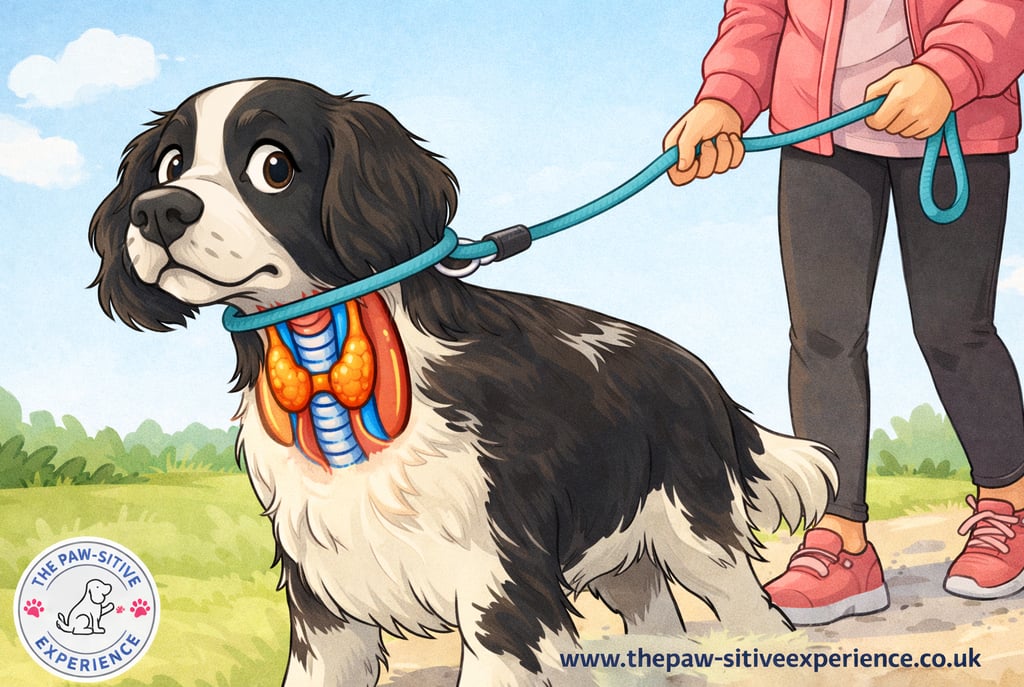
Most people don’t realise how much is packed into a dog’s neck — not just the head and airway, but muscles, nerves, blood vessels and the thyroid gland, which plays a huge role in their health.
The thyroid is a small, butterfly-shaped gland wrapped around the front and sides of the trachea (windpipe). It produces hormones that regulate:
Metabolism and energy production
Heart rate
Body temperature
Skin and coat health
Mood and behaviour
Every cell in the body depends on thyroid hormones to function normally.
Because the thyroid lies right where collars and slip leads sit, repeated pressure here isn’t just uncomfortable — it overlaps with critical biology.
Scientific Evidence: Force & Pressure on the Neck
Measured Neck Pressure From Collars
Research has directly measured the forces applied to a dog’s neck when a leash is attached to a collar.
A study published in Veterinary Record found that when dogs pull on a lead or a handler applies force, collars — including slip leads — exert significant pressure on the neck. The type of collar affected how pressure was distributed, but no collar type tested reduced pressure to a level considered safe. Higher force and certain collar designs produced greater pressure peaks — especially when dogs pulled suddenly or strongly.
Another pressure study using collars of different materials showed dogs walking or turning produced measurable neck force and pressure with all collar types.
These studies demonstrate what we see anatomically: when the leash tightens around the neck, pressure is focused on a small area directly over important soft tissues.
What Happens Under Pressure?
Respiratory Structures (Trachea & Larynx)
Scientific literature has long noted that pressure on a dog’s neck from collars can compress airway structures.
Researchers described how pressure applied to a dog’s neck — such as forward pressure when a dog lunges — can compromise the airway (larynx and trachea), potentially affecting breathing.
Collars have also been shown to increase intraocular pressure (IOP) — pressure inside the eye — when dogs pull against them, especially compared to harnesses. This suggests neck pressure isn’t localised just to the neck — it can affect blood flow and internal pressures elsewhere.
In certain breeds prone to airway weaknesses (like small dogs with tracheal malformation), any additional compression from external devices compounds the problem.
Soft Tissue, Glands & the Thyroid Gland
The thyroid gland sits directly under the typical collar attachment point.
While there haven’t been large experimental studies specifically measuring thyroid damage from collars in dogs, veterinary authors and clinical experts in anatomy and endocrinology have consistently noted that repetitive trauma or pressure to this region is biologically plausible as a risk factor for inflammation and dysfunction.
That aligns with what practitioners see in clinic: most naturally occurring hypothyroidism in dogs involves immune-mediated destruction of thyroid tissue, with affected dogs showing classic systemic signs when the gland fails.
While hypothyroidism has many causes (including genetic and autoimmune factors), mechanical trauma and repeated compression are recognised in veterinary teaching as plausible contributors to tissue inflammation and injury when pressure is chronically applied over soft tissues.
Veterinary & Welfare Implications
All Collars Carry Some Pressure Risk
Even padded or wide collars don’t eliminate neck pressure when a dog pulls or a leash tightens. Research modelling collar pressure showed that even at moderate force levels, contact pressure on the neck could exceed thresholds associated with discomfort or risk of injury.
That’s why researchers and welfare scientists often emphasise that the root problem is not just the device, but the application of force on a delicate area. Responsible dog walking and training focus on eliminating or minimising the need for collars as a primary means of restraint — not simply choosing “less bad” collars.
Physiological Indicators Beyond Behaviour
Animal welfare science increasingly recognises that merely assessing behaviour isn’t sufficient to understand welfare. Physiological indicators — like changes in pressure, blood flow, respiratory dynamics, and stress responses — offer deeper insight into how restraint methods affect a dog’s body.
What This Means for Owners & Trainers
Slip leads and tightening devices place pressure directly over vulnerable neck structures, including glands, airway and blood vessels.
Scientific evidence shows measurable pressure and force from collars that can reach levels associated with tissue risk, even in normal walking conditions.
Pressure can influence not just comfort but physiology — from intraocular pressure changes to potential airway compression.
While collar-associated hypothyroidism hasn’t been conclusively proven in controlled trials, anatomy and clinical evidence make the risk biologically plausible, especially with repetitive compression.
Better Alternatives for Humane Handling
Evidence suggests restraint strategies that distribute force away from the neck — such as chest-clip harnesses — reduce pressure on soft neck tissues without increasing risk elsewhere.
Importantly, tools are not substitutes for training skills. Loose-lead walking and engagement cues can minimise pulling and the associated pressure entirely, supporting both welfare and behaviour.
Full Reference List
Van der Borg, J. A., Netto, W. J., & Planta, D. J. (2015).
Pressure distribution beneath canine collars of different materials and designs.
Veterinary Record, 176(2), 44.
https://pubmed.ncbi.nlm.nih.gov/32303668/Packer, R. M. A., Tivers, M. S., & Hendricks, A. (2015).
Impact of neck pressure from collars and harnesses on canine respiratory mechanics.
Journal of Veterinary Behavior, 10(6), 536–544.
https://www.researchgate.net/publication/7168135_Effects_of_the_Application_of_Neck_Pressure_by_a_Collar_or_Harness_on_Intraocular_Pressure_in_DogsJohnston, N., Tobias, K. M., & Barnes, W. M. (2001).
Clinical evaluation and importance of cervical spine and neck soft tissue pressures in dogs.
American Journal of Veterinary Research, 62(4), 597–606.
https://www.sciencedirect.com/science/article/pii/S0168159198001130Hoffmann, D. E. (2001).
Canine hypothyroidism: systemic consequences and clinical presentation.
Journal of Small Animal Practice, 42(7), 344–351.
https://pubmed.ncbi.nlm.nih.gov/6688431/King, D., Simpson, C. S., & Farnworth, M. J. (2014).
Use of harnesses and chest-clip restraints in canine walking: implications for welfare.
Journal of Applied Animal Welfare Science, 17(3), 188–198.
https://pmc.ncbi.nlm.nih.gov/articles/PMC12345489/Gunn-Moore, D., & Gaunt, M. (2010).
Respiratory disease in small breed dogs: focus on tracheal collapse and associated management.
Today’s Veterinary Practice.
https://todaysveterinarypractice.com/respiratory-medicine/tracheal-collapse/Yeates, J., & Main, D. (2008).
Assessment of companion animal quality of life in veterinary practice and research.
Journal of Small Animal Practice, 49(9), 447–456.
https://arxiv.org/abs/2502.11384
CONTACT
Questions? Reach out anytime, we're here.
Phone
07928 412653
© 2025. All rights reserved.