
Why Spaniels Find Loose-Lead Walking So Hard — And How to Help Them Succeed
Discover why spaniels find loose-lead walking so challenging and how their natural instincts, scent-driven behaviours, and high arousal levels affect pulling. This breed-specific guide explains the science behind spaniel behaviour and offers practical, force-free training tips to help your spaniel walk calmly on the lead.
11/23/20253 min read
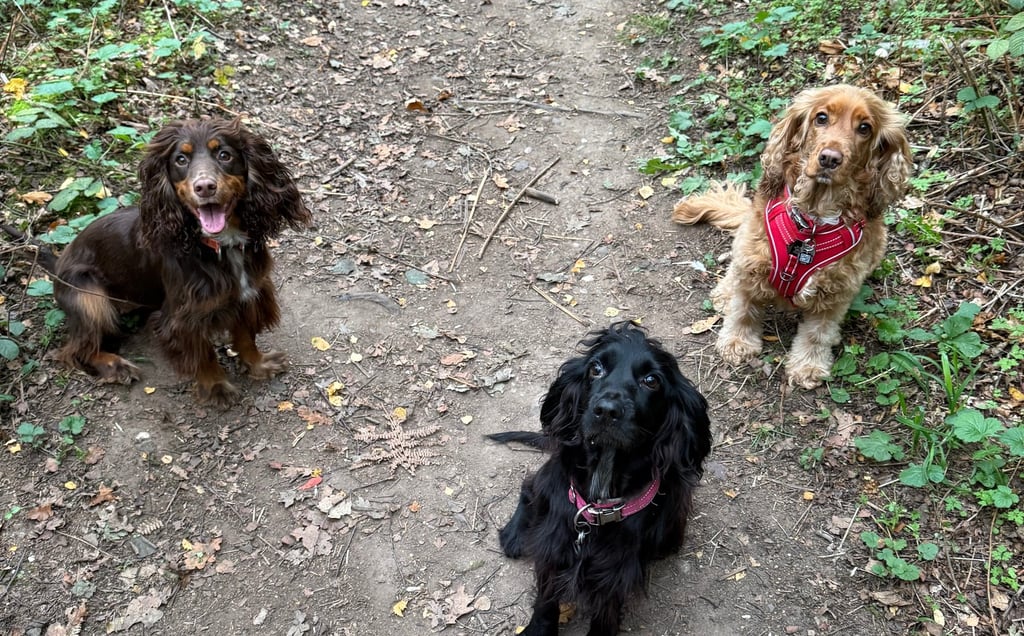
Spaniels are one of Britain’s favourite dogs (if you know me, you know they’re mine) — bright-eyed, waggy-tailed, endlessly enthusiastic, and always ready for adventure. But if you own a spaniel, you’ll know one thing for certain:
Loose-lead walking does NOT come naturally. At all.
If you’ve ever found yourself being “spaniel-ski’d” down the pavement, you’re not alone. Spaniels around the world are notorious pullers — and it’s not because they’re naughty, stubborn, or ignoring you.
It’s because they were designed to be exactly like this.
This blog dives into:
The breed history behind spaniel pulling
The science of scent, arousal, and self-control
The instinctive behaviours that take over on walks
Fun facts about spaniel noses and brain wiring
Practical, kind, force-free training strategies that actually work
Why Spaniels Pull: The Breed-Specific Truth
1. They are bred to move out ahead
Spaniels were originally developed as flushers — dogs who worked in front of the handler, pushing through cover to find game birds.
Their built-in operating system says:
“Go out. Search. Push forward. Cover ground.”
So when you ask a spaniel to walk next to you, at human speed, ignoring the world around them… you’re asking them to act against centuries of genetics.
2. They have hyper-sensitive noses (even more than other gun-dogs)
All dogs have powerful noses — but spaniels are something else.
Fun scent facts:
A spaniel’s nose has 220 million+ scent receptors
Their brain devotes 40× more space to smell than ours
Their nostrils can move independently
They can detect a scent diluted to 1 part per trillion
Spaniels don’t just notice smells. They get flooded with dopamine when they follow them.
So every sniffy pull forward isn’t defiance — it’s a neurological reward loop.
3. High arousal + high drive = high pulling power
Spaniels sit high on the arousal curve — they become excited FAST and stay excited.
Working-bred spaniels in particular:
move quickly
think quickly
react quickly
escalate quickly
Loose-lead walking requires:
patience
self-control
stillness
slowed pace
These are hard skills for a high-arousal breed.
4. They’re bred to ignore discomfort
Spaniels push through:
brambles
nettles
thorn bushes
icy water
dense cover
So a bit of pressure on the collar?
They barely register it.
This is why yanking or correction-based tools (slip leads, choke chains) rarely teach them anything — they’re simply too tough and too driven.
The Science: Why Pulling Rewards Itself
Pulling is a self-reinforcing behaviour.
If the dog pulls → they reach the smell, the person, the bird, the leaf that moved → dopamine hits → behaviour strengthens.
This loop repeats hundreds of times per walk.
To change the behaviour, we must:
reduce reinforcement for pulling, and
massively reinforce staying close to you.
Fun Spaniel Facts (because we love them)
A spaniel’s ears act like scent scoops, funnelling smells toward their nose.
Many spaniels perform a behaviour called “air-scenting”, lifting their head to sample scent particles in the breeze.
Their famous “spaniel wiggle” is linked to high serotonin levels when excited.
Spaniels are one of the few breeds who naturally work in a zig-zag quartering pattern, which makes straight walking difficult.
Their tail action (the fast helicopter spin) is a sign of intense olfactory stimulation.
How to Actually Teach Loose-Lead Walking to a Spaniel
Here are spaniel-specific, force-free strategies that work.
1. Lower arousal before the walk
Loose lead walking begins before you leave the house.
Try:
Scatter feeding in the garden
3–5 minutes of nose-work/sniffy games
Slow patterned engagement (123 game, zen hand, focus games)
Sitting calmly with a chew for 2 minutes
A spaniel starting at 8/10 arousal will pull.
A spaniel starting at 4/10 can learn.
2. Reinforce proximity — heavily
Spaniels love:
food
movement
hunting games
Use these to your advantage.
Reward:
eye contact
checking in
staying in the “reinforcement zone” by your leg
choosing you over the environment
At first, reward a lot — every 1–2 steps.
3. Give them legal sniffing time
Spaniels need to use their noses.
Build sniff breaks into the walk:
cue: “Go sniff”
20–40 seconds of exploring
then return to structured walking
This massively reduces frustration.
4. Use a longline for decompression walks
A 5–10 metre longline gives spaniels:
space to move
space to sniff
freedom to be themselves
Use these sessions to satisfy their breed needs so your on-lead training walks become easier.
5. Teach “pattern games” to regulate the brain
Spaniels thrive with predictable patterns:
123 walking game
Up/Down (treat on ground → treat to hand)
Ping-pong recall
Middle position reset
Patterns lower arousal and improve focus.
6. Train in low-distraction environments FIRST
Spaniels are easily overwhelmed by:
scents
birds
movement
sounds
Start indoors. Then garden. Then driveway. Only then go to the real world.
7. Keep sessions short
5 minutes of good quality loose-lead work is better than 40 minutes of being dragged. Spaniels learn FAST in short doses.
8. Use the right equipment
Recommended:
Y-front harness (non-restrictive, comfortable)
2–3 metre training lead
Treat pouch full of high-value rewards
Avoid:
slip leads
choke chains
head-collars that cause panic in sensitive dogs
extendable leads (encourage pulling)
Final Thoughts
Spaniels aren’t being difficult when they pull — they are being spaniels.
They are:
scent-driven
birdy
excitable
enthusiastic
bred to work ahead of the handler
Loose-lead walking is a trained skill, not something this breed naturally offers.
But with:
realistic expectations
the right techniques
arousal management
plenty of sniff time
clear reinforcement patterns
…spaniels absolutely can learn beautiful loose-lead walking. And when they do? They’re an absolute joy to walk.
CONTACT
Questions? Reach out anytime, we're here.
Phone
07928 412653
© 2025. All rights reserved.