
What Your Dog Walker Notices That You Might Miss
A professional dog walker does far more than cover miles. Discover what an experienced walker notices about your dog’s movement, behaviour, and emotional wellbeing — and why it matters more than you might think.
7/12/20264 min read
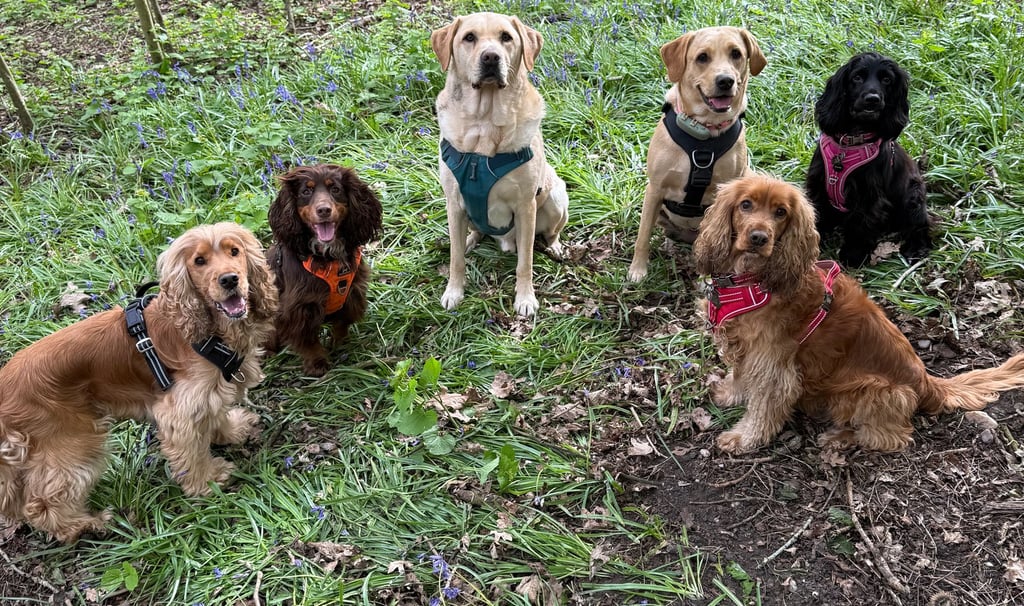
You hand over the lead. You head to work. You trust that your dog is in good hands.
And they are.
But here’s something most owners don’t realise: a professional dog walker isn’t just providing exercise. They’re spending significant time with your dog, in the real world, watching them move and interact and cope — often noticing things that are genuinely hard to spot from inside a busy family home.
This isn’t about catching problems. It’s about knowing your dog deeply enough to notice when something has shifted.
And that kind of observation is one of the most valuable things a professional brings to the relationship.
The Way They Move
Most owners see their dog moving in familiar environments — the garden, the local park, the usual route. A walker sees them across different terrain, different conditions, different energy levels.
And movement tells you a lot.
A subtle change in gait. A slight favouring of one leg that wasn’t there last week. A reluctance to jump into the van that used to be effortless. A stiffness in the first few minutes that loosens — or doesn’t.
These aren’t always obvious. They’re easy to miss when you’re rushing out the door or walking the same route on autopilot. But when you’re watching dogs move day after day, the baseline becomes familiar — and deviations from it stand out.
More than once, a walker has been the first to notice the early signs of an injury or joint issue that a vet later confirmed. Yes
Not because the owner wasn’t paying attention, but because they didn’t have the same daily reference point.
The Way They Interact
Group dynamics are endlessly revealing.
A dog who is usually confident and engaged but suddenly hanging back. A dog who normally plays freely but is avoiding a particular dog without obvious reason. A dog who is seeking more reassurance than usual, checking in more frequently, less willing to move away from the handler.
None of these things are dramatic. None of them would necessarily show up on a normal walk.
But in a group, with a walker who knows the individuals well, these shifts are visible — and they matter. Sometimes they signal something physical. Sometimes something emotional. Sometimes they reflect something happening at home that the dog is carrying with them.
Dogs don’t compartmentalise. What happens in their life shows up in their behaviour.
The Way They Cope
How a dog handles the unexpected is one of the most telling things a walker observes.
A sudden noise. An unfamiliar dog approaching. A change in the usual route. A piece of farm equipment in a field they walk past every week.
How does your dog respond? Do they startle and recover quickly? Do they startle and take a long time to come back down? Do they freeze? Do they look to the handler for reassurance and find it easily, or do they struggle to settle?
Recovery time is one of the most important indicators of a dog’s emotional wellbeing — and it’s something that’s very difficult to assess without consistent, real-world observation over time.
A dog whose recovery time is getting longer isn’t necessarily having bad days. They might be carrying more stress than usual. They might be in low-level discomfort. They might be approaching a developmental stage that’s making the world feel bigger and harder — as adolescence often does, something I explored in Adolescent Dogs: Why Everything Feels Harder.
Whatever the reason, knowing that the recovery time has changed is useful information.
The Way They Drink — and Everything Else
The small things add up.
Drinking more than usual on a cool day. Not drinking at all on a warm one. Eating grass persistently. Scooting. Unusual toileting. A coat that’s lost its usual condition. Eyes that look a little dull. Energy that seems flat when it’s usually bright.
None of these things are diagnoses. A good walker isn’t a vet, and they’d never suggest they were.
But they are observations — passed back to owners who can then decide whether something warrants a closer look.
The Way They’ve Changed
Perhaps the most valuable thing a long-term walker notices is progress — or the absence of it.
A dog who used to struggle with other dogs on the lead and now passes calmly. A dog who used to be hard to load into the van and now jumps in without hesitation. A dog who used to take twenty minutes to settle into a walk and now hits their stride within five.
Progress in dogs, as we know, is rarely linear — What Progress Really Looks Like in Dog Training — but a walker who sees a dog regularly has a longer view than almost anyone else in that dog’s life.
They see the trend. They see the drift. They see when things are moving in the right direction — and when something has quietly shifted the other way.
Why This Matters
This isn’t about surveillance. It’s about relationship.
A good professional dog walker knows your dog. Not just their name and their favourite treat — but their baseline. Their normal. Their tells.
That knowledge is built slowly, over dozens of walks, across changing seasons and moods and life stages. It can’t be replicated by someone new, and it can’t be replaced by a camera on the walk.
It’s the kind of quiet, consistent attention that is easy to overlook — right up until the moment it catches something important.
The Bottom Line
When you hand over the lead, you’re not just paying for miles covered.
You’re paying for eyes that know your dog. For someone who notices the subtle shift in how they’re moving, coping, or carrying themselves — and who cares enough to say something.
That kind of professional relationship has real value.
And your dog benefits from it every single walk.
CONTACT
Questions? Reach out anytime, we're here.
Phone
07928 412653
© 2025. All rights reserved.