Beyond "He’s Fine with Kids": Why the KAD Protocol is a Game-Changer for Families
Many dogs don’t “love” everything children do — they tolerate it. This blog explains why that matters, how stress builds, and how the Kids Around Dogs (KAD) approach helps create safer, more respectful relationships.
4/26/20263 min read
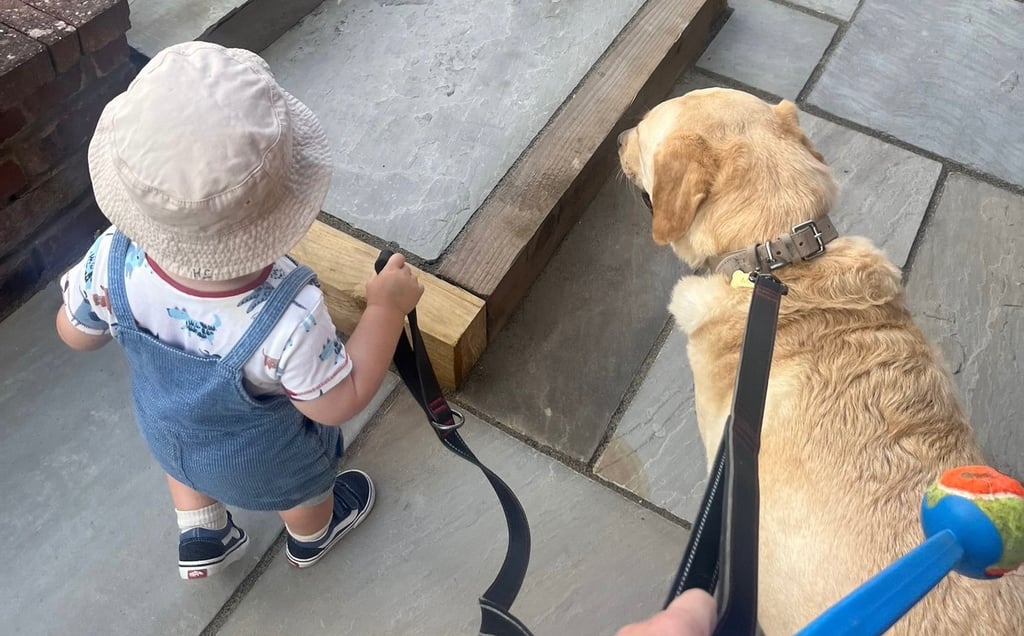
If you have a dog and a child, you’ve likely said—or heard—the phrase, "He’s brilliant with kids, he lets them do anything." As a trainer, that phrase actually makes me hold my breath. When we say a dog "lets them do anything," we are often describing a dog that is tolerating behavior rather than enjoying it. Tolerance has a limit. Every time a dog has to "put up" with being hugged, leaned on, or disturbed while sleeping, a little more goes into their Stress Bucket. This idea of a dog’s “Stress Bucket” is something I talk about in more detail in another blog, and it plays a huge role in how dogs respond to children and busy environments.
This is why I use the Kids Around Dogs (KAD) protocol. It moves us away from "hope" as a safety strategy and toward a relationship built on mutual respect and biological understanding.
The Myth of the "Smiling" Dog
One of the most eye-opening parts of the KAD framework is understanding how children perceive dogs. Research shows that a huge percentage of young children (up to 69% of 4-year-olds) actually interpret an angry, snarling dog as "smiling" or "happy."
To a child’s eyes, bared teeth look like a grin. To a dog, it’s a clear "Stop" sign. If we don't teach children how to read the subtle language of the species living in their lounge—the lip licks, the "whale eye," the stiffening of the body—we are setting both the child and the dog up for a fall.
Understanding what your dog is really communicating is key — especially when their behaviour is often misunderstood. You can read my blog Here
What is the KAD Protocol?
KAD is an award-winning association of professionals dedicated to helping children and dogs live in harmony. As an approved professional, I work with families to:
Decode Canine Body Language: Teaching kids (and parents!) that a wagging tail doesn't always mean happy, and that "leaning in" is often an intrusive behavior that dogs find threatening.
The "3-Second Rule": Teaching children to pet for three seconds, then stop and move their hand away. If the dog moves back in, they want more. If they stay still or move away, they’re done. This gives the dog a choice.
Safe Zones: Establishing that the dog’s bed or crate is an "off-limits" sanctuary. If the dog is there, they are "invisible" to the children.
Active Supervision vs. "Just Being in the Room"
We often think that because we are in the same room, we are supervising. But active supervision means watching the interaction, not just the individuals.
Is the child leaning over the dog’s face?
Is the dog’s body tense?
Are they looking for an exit?
The KAD protocol gives parents the "eyes" to see these moments before they escalate. This is exactly how many behaviour issues begin — small signs being missed until the dog feels they have no other option. You may like read about my blog on reactivity to learn more.
It’s about being proactive, not reactive.
Helping Children Overcome Fear
KAD isn't just for families who already have dogs. The protocol is also designed to help children who are terrified of dogs. Using a specific, 10-session graduated process, we help children understand dogs from a distance, unmasking the "unknowns" that feed their fear. We use games, "decoy" dog models, and eventually, carefully assessed dogs to build their confidence at a pace that feels safe for them.
The KAD Goal: Empowerment, Not Restriction
The goal isn't to stop kids from interacting with dogs; it's to empower them to do it safely and kindly. * We involve children in the dog’s care—filling water bowls, helping with enrichment, or joining the "Sniffari."
We teach them that dogs are sentient beings with their own "Stress Buckets" and need for space.
When a child learns to respect a dog's boundaries, the bond between them changes. It moves from a child "playing with a toy" to two companions who truly understand each other.
The Bottom Line
Safety isn't about having a "bomb-proof" dog; it’s about having an educated family. Whether you’re preparing for a new baby, struggling with a boisterous toddler, or helping a child overcome a phobia, the KAD protocol provides the scientific framework to make it work.
If you have children and a dog, or you’re preparing for that stage, this is something I can support you with through my Kids Around Dogs sessions and 1-to-1 training.
CONTACT
Questions? Reach out anytime, we're here.
Phone
07928 412653
© 2025. All rights reserved.