The "Stress Bucket" & The Safe Distance Bullseye: Why Your Dog Can’t "Hear" You When They’re Over-Threshold
Why does your dog seem to forget everything outdoors? This blog explains the science behind stress, trigger stacking and why dogs can’t always respond to cues — plus what actually helps.
4/19/20264 min read

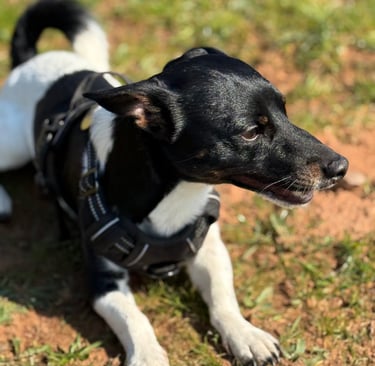
We’ve all been there. You’re out on a walk, your dog sees a squirrel or another dog, and suddenly, it’s like you don’t exist. You’re giving your cues—the ones they follow perfectly in the kitchen—but your dog is checked out, lunging, or barking.
It’s easy to feel frustrated or think your dog is being "stubborn." This is something I see all the time, and it often links back to how dogs cope with pressure and stimulation in the environment — something I talk about more in my blog on why “over-excited” dogs are often actually stressed. But the reality is scientific. In that moment, your dog’s brain has physically lost the ability to process your cues. To fix it, we need to visualise two things: the Stress Bucket and your Safe Distance Bullseye.
1. Visualising the Stress Bucket
Imagine your dog has a bucket. Every time they experience something stressful, exciting, or scary, "water" (stress hormones like cortisol and adrenaline) is poured in.
The morning postman: A splash in the bottom.
The neighbours dog barking through the fence: Another splash.
A car backfiring: A cupful.
By the time you get to the park, that bucket might already be three-quarters full. Then, when a "friendly" dog charges up, the water hits the rim and spills over. This is Trigger Stacking. When the bucket overflows, the "learning" part of the brain—the part that listens to your cues—shuts down. The "survival" center takes over. You cannot train a dog whose bucket is overflowing; you can only manage the mess. This idea ties closely into understanding your dog’s threshold levels — when they are able to cope, and when they are simply overwhelmed. You can read more Here
2. Visualising the Safe Distance Bullseye
If the bucket is the internal state, the Bullseye is your external map. Picture a massive target painted on the ground around the "distraction" (the other dog, the cyclist, or the squirrel).
The Green Zone (The Outer Ring): This is "Too Far." Your dog might know something is there, but they aren't bothered. It’s safe, but they aren't really learning because the challenge is too low.
The Orange Zone (The Sweet Spot): This is the middle ring. Your dog notices the distraction, their ears might prick, and they might look for a second—but they can still choose you. They can disengage and take a treat. This is your workable distance where progress happens.
The Red Zone (The Bullseye/Too Close): This is the center. You’ve crossed the line. The bucket has overflowed. Your dog is lunging, barking, or "locking on" (fixating). Learning has stopped. This is often the point where behaviours like barking or lunging appear, which many owners experience as “reactivity”. The key skill for any handler is Distance Management. If you see the "Build Up"—the tail going stiff, the body tension, the "statue" freeze—you are sliding from Orange into Red. Your job isn't to "correct" the dog; it’s to move your feet, create distance immediately, and get back into that safe Orange ring.
How to Empty the Bucket: The Recovery Toolkit
The challenge is that cortisol can stay in a dog’s system for several days. To get back to a "Green Zone" baseline, we have to actively drain the bucket.
The "Sniffari"
A Sniffari isn't a walk for exercise; it’s a walk for the nose. Put your dog on a long line (attached to a harness, never a collar) and let them lead the way. If they want to spend five minutes sniffing one blade of grass, let them. Sniffing lowers a dog's heart rate and acts like a "drainage valve" for the stress bucket. This is one of the reasons I often talk about how important sniffing is for dogs, not just for enrichment but for emotional regulation.
Ditch the Bowl: Interactive Feeding
If your dog's bucket is full, don't just put their dinner in a bowl. Make them use their brain and mouth to decompress:
Scatter Feeding: Toss their kibble into the grass or a Sniff Mat. Searching for food is a natural "seeking" behavior that builds confidence.
Licking Activities: Use a Lick Mat or a Honeypot/Kongs/Toppls stuffed with wet food, yogurt, or mashed banana. The rhythmic action of licking is neurologically calming.
Long-Lasting Chews: Bully sticks, yak chews, or natural hide. Chewing releases endorphins that help "reset" the nervous system.
Decompression Days
Sometimes, the best walk is no walk at all. More exercise isn’t always the answer, and in some cases it can actually make things worse — something I go into more detail about in my blog on tired dogs and behaviour. If your dog has had a "Red Zone" day, give them 24-48 hours of quiet time. Focus on garden play, indoor enrichment, and plenty of quality sleep. Just like us, dogs need rest to process the "water" in their bucket.
The Bottom Line
Training is about setting your dog up to succeed. If you're in the Red Zone, you've gone too far. Don't get frustrated that they aren't "listening"—look at the bucket, look at the bullseye, and back up. Find the Orange, find the calm, and help your dog make a better choice.
If this sounds familiar, you’re not alone. This is exactly the kind of thing I help with in my 1-to-1 training sessions, where we look at your dog as an individual and build a plan that works in real life.
CONTACT
Questions? Reach out anytime, we're here.
Phone
07928 412653
© 2025. All rights reserved.