
What Your Dog’s Sniffing Actually Means
Why do dogs sniff so much on walks? Discover how scent shapes the way dogs experience the world and why sniffing is important for enrichment, relaxation and understanding their environment.
3/29/20264 min read
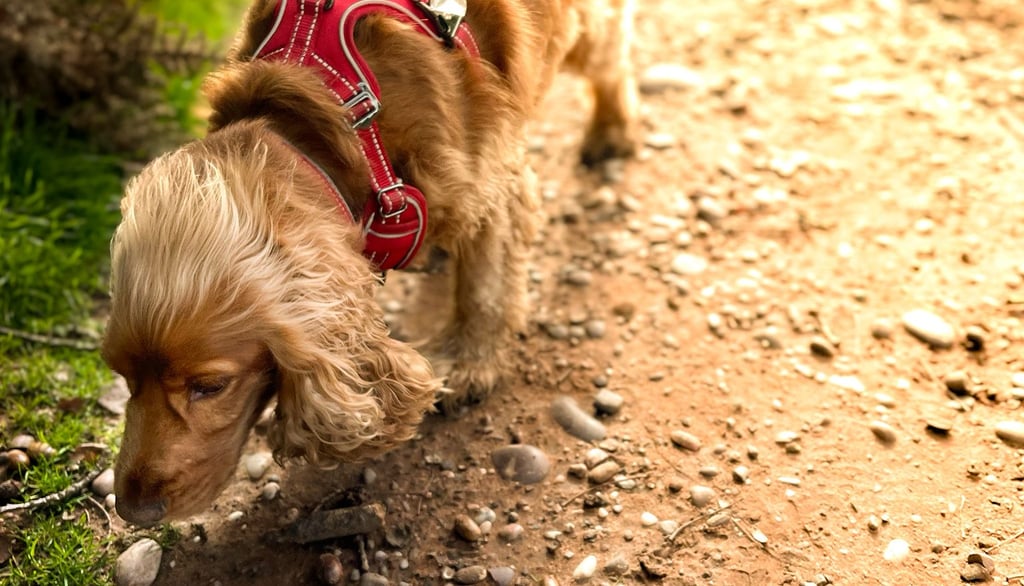
One of the most common sights on a dog walk is a dog with their nose firmly pressed to the ground, moving slowly from one interesting scent to the next. For many owners, this behaviour can feel frustrating. Walks slow down, progress stops, and it may seem as though the dog is ignoring their owner completely. But sniffing is not simply a distraction. For dogs, sniffing is one of the most important ways they experience and understand the world around them. Understanding why dogs sniff can completely change the way we view walks.
Dogs Experience the World Through Their Nose
Humans rely heavily on sight to interpret the world around us. Dogs, however, experience their environment very differently. A dog’s sense of smell is estimated to be tens of thousands of times more powerful than our own. Their brains are designed to process scent information in extraordinary detail. Where we see grass, pavement and trees, dogs detect layers of scent left by other animals, people and environmental changes. Each scent provides information about who passed through the area, how long ago they were there and sometimes even emotional information such as stress or excitement. To a dog, a walk is not simply physical exercise — it is a constantly changing landscape of scent information.
Sniffing Is Mental Enrichment
Because scent is so important to dogs, sniffing plays a huge role in mental stimulation. When dogs sniff, they are actively analysing and processing information about their surroundings. This engages their brain in a way that physical movement alone cannot. For many dogs, especially intelligent or working breeds, this type of mental activity is incredibly satisfying. In fact, allowing dogs to explore scents can often leave them feeling more content and relaxed than simply walking quickly from one place to another.
Sniffing Can Help Reduce Stress
Research has shown that sniffing can actually help dogs relax. Slow, exploratory sniffing encourages dogs to move at a calmer pace and can reduce heart rate and overall arousal levels. This is one reason why many trainers encourage owners to allow some time for dogs to sniff during walks. If a dog spends the entire walk in a highly stimulated or rushed state, it can become difficult for them to settle once they return home.
The relationship between arousal, calmness and behaviour is something I explore in more detail in Why Calm Is a Skill (Not a Personality Trait).
Sniffing and the Outside Environment
The outside world is full of scent information that is constantly changing. Other dogs may have walked through an area earlier in the day. Wildlife may have passed during the night. Even subtle environmental changes can leave scent traces. For dogs, these scents provide valuable information about what is happening in the world around them. This is one reason why many dogs appear far more interested in the environment than their owner when they are outside. The environment itself is full of meaningful signals.
If your dog seems far more distracted outside than they are at home, this is completely normal. You may find it helpful to read Why Dogs Listen at Home But Ignore You Outside, which explores how environmental stimulation affects behaviour.
Sniffing Doesn’t Mean Your Dog Is Ignoring You
Sometimes owners worry that sniffing means their dog is ignoring them or being disobedient. In reality, the dog is simply responding to powerful sensory information in the environment. Sometimes it helps to think about sniffing from the dog’s perspective. Imagine someone pulling a book out of your hands halfway through an interesting chapter. That’s a little like what it can feel like for a dog when they are deeply engaged in a scent and are suddenly pulled away. For the dog, that scent may contain a huge amount of information they are still processing. Interrupting that moment too quickly can feel frustrating and confusing, particularly for dogs who rely heavily on scent to understand their environment. Because scent is such a strong motivator, it can sometimes compete with a dog’s attention. This is especially true when dogs encounter areas where many other animals have passed through. Understanding this helps explain why some environments feel much harder for dogs than others.
When this happens, dogs may struggle to focus on their owner or respond to cues. This idea is closely linked to training thresholds, which are discussed further in Thresholds in Dog Training: Why Timing Matters.
Walks Are About More Than Exercise
Many people assume that the purpose of a walk is simply physical exercise. But for dogs, walks are also about exploration, learning and engaging with their environment. Sniffing allows dogs to gather information, process their surroundings and interact with the world in a natural way. When dogs are given opportunities to explore scent, it can make walks more enriching and satisfying. Understanding this perspective can help owners see walks in a new light. Rather than focusing only on distance or speed, walks can become an opportunity for dogs to engage with their environment in a way that supports both their mental and emotional wellbeing.
A Different Way to View Walks
Rather than seeing sniffing as something that slows the walk down, it can be helpful to view it as an essential part of how dogs explore and experience the world. When dogs are given opportunities to engage with their environment through scent, walks can become more satisfying, enriching and calming. For many dogs, those moments of quiet exploration are just as valuable as the movement itself.
Understanding Your Dog’s Behaviour on Walks
When we begin to understand why dogs sniff, many behaviours that once seemed frustrating start to make much more sense. Dogs are not simply wandering aimlessly or ignoring their owners. They are exploring a complex world of scent information that humans cannot easily perceive. Learning to recognise and understand these behaviours can help strengthen the relationship between dogs and their owners.
If you’re interested in understanding your dog’s body language and behaviour outdoors, you may also enjoy reading What Your Dog Is Really Telling You on Walks.
If you’d like support building calm focus and engagement with your dog in real-world environments, you can find more information about my training services here:
www.thepaw-sitiveexperience.co.uk
Based in Stourbridge, I work with owners to help dogs develop calm, confident behaviour both at home and out in the world.
CONTACT
Questions? Reach out anytime, we're here.
Phone
07928 412653
© 2025. All rights reserved.