
The “Watch and Wait”: Why Doing Nothing is the Ultimate High-Level Skill
Why is doing nothing so hard for dogs? This blog explores the science behind calmness, self-control and arousal, and explains why the ability to simply “watch and wait” is one of the most valuable real-life skills a dog can have.
5/17/20263 min read
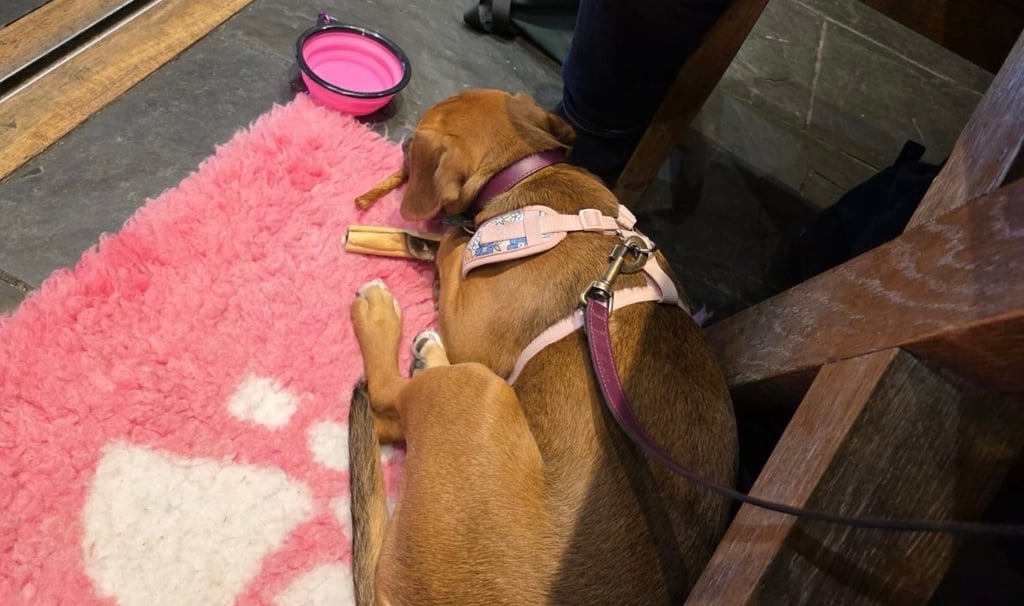
In the world of dog training, we often focus on the “flashy” stuff: the fast recalls, the crisp sits, or the impressive tricks. But if you asked me what the most valuable skill a dog can have in the real world is, my answer might surprise you. It’s the ability to do absolutely nothing.
I call this the “Watch and Wait.” It’s that moment at a cafe, on a park bench, or even just waiting for a friend to chat on the street where your dog simply exists in a state of calm.
The Metabolic Cost of Stillness
From a biological perspective, “doing nothing” is an incredibly active process. For a sentient being with a high drive or a full Stress Bucket, staying still in the face of distractions requires massive amounts of inhibitory control.
If you’ve read my blog on the Stress Bucket and Safe Distance Bullseye, you’ll know that many dogs are already carrying a level of underlying stress before we even step out the door — which makes this kind of stillness even more difficult.
In the brain, this is a battle between the Sympathetic Nervous System (the “Go” system) and the Parasympathetic Nervous System (the “Slow” system). When your dog sees a squirrel but stays lying down, their prefrontal cortex is working overtime to inhibit the motor response to chase. This consumes a significant amount of glucose and oxygen. This is why “calmness training” often leaves a dog more tired than a five-mile hike.
This is also why simply adding more physical exercise doesn’t always solve the problem — something I explore further in my blog on why tired dogs aren’t always happy dogs.
The Equilibrium Goal
We often talk about Homeostasis—the body’s drive to maintain a stable internal environment. A dog that is constantly “on” is in a state of chronic high arousal (remember the cortisol we talked about in Stress Bucket and Safe Distance Bullseye?)
Teaching the “Watch and Wait” is about training the nervous system to return to a baseline of calm quickly. We aren’t looking for a “statue” who is vibrating with suppressed energy; we are looking for a dog whose heart rate is low and whose breathing is rhythmic.
This idea of calm not just being the absence of movement, but a true emotional state, is something that’s often misunderstood — particularly in dogs that are labelled as “over-excited,” which I go into more detail about in my blog on why “over-excited” dogs are often actually stressed.
How to Build the “Inhibitory Muscle”
You don’t start the “Watch and Wait” in the middle of a busy Stourbridge market. You build it in layers:
The “Nothing” Minute: Practice at home. Sit on the sofa and ignore your dog for 60 seconds. No cues, no eye contact. Just “being.”
The Garden Session: Move to the garden. Sit in a chair and let the world go by. Reward the moments your dog chooses to lie down or sniff a single spot without “searching” for a task.
The “Middle Distance”: Take it to a quiet park bench. Use your Safe Distance Bullseye to ensure you are in the “Green” or “Orange” zone. If your dog is fixating, they aren’t “waiting”—they are “loading.” Move further away until they can truly relax.
This is something I spend a lot of time working on in my classes. In puppy class, we dedicate a full session to building calmness and helping dogs learn how to switch off, and it’s something we continue to develop throughout the adolescent course as distractions and arousal naturally increase. It’s one of the most important real-life skills your dog can learn — and one that’s often overlooked.
Why it Matters for the Handler
The “Watch and Wait” isn’t just for the dog; it’s for the handler, too. It changes the walk from a “chore” or a “mission” into a shared experience. It allows you to observe your dog’s subtle body language—the way their nostrils flare to catch a scent or the soft “huff” they give when they finally settle.
If you’ve tried a Sniffari, you’ll notice a similar shift — stepping back and allowing your dog to simply exist in their environment rather than constantly directing them.
The Bottom Line
A dog that can “do nothing” is a dog that can go anywhere. Whether you’re stopping for a coffee in Hagley or waiting for the vet in Stourbridge, the “Watch and Wait” is the foundation of a low-stress life.
Next time you’re out, don’t feel like you have to be constantly “training” or moving. Sometimes, the best training you can do is simply to sit down, take a breath, and do nothing at all.
CONTACT
Questions? Reach out anytime, we're here.
Phone
07928 412653
© 2025. All rights reserved.